
Featured Exhibition
6 min
Coming Home
Image: Buckingham Palace, London / CCGW Collection / 2016.3.1.1-154

Soldiers' Land Settlement Scheme, cover [1919]
Canadian War Museum
Hartland-Molson Library Collection
REF PAM UB 359 C2 S61 1919
The Canadian government created the Department of Soldiers’ Civil Re-Establishment in 1918 to help returning soldiers re-adjust to their lives at home. The Department’s initiatives included hospital care, employment assistance, vocational training, and a pensions program.
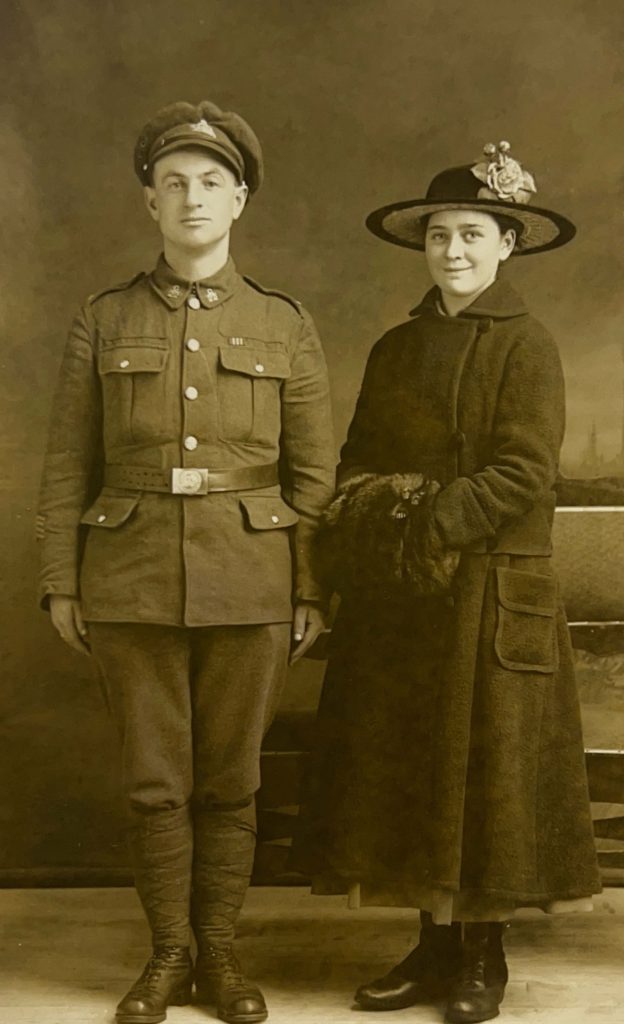
Pte. Arsène Bélanger with an unknown woman, c. 1918-1919
Canadian Centre for the Great War
2014.05.01.01-02
Fifth and Seventh Batteries, CFA arriving in Montreal PQ for demobilization, 1919.
Dept. of National Defence
Library and Archives Canada
PA-022997
Image: Veteran's Parade / Gift of J. Viktor Taboika / CCGW Collection / 2017.06.61
Amputations Association
[of the Great War] convention
Sept. 12, 1932.
City of Vancouver Archives
AM1535-:CVA99-4257
Service Bureaus offered returning soldiers assistance in searching for employment. The Great War Veterans’ Association (GWVA) had 163 centers across Canada to give veterans assistance with applications and to represent them on government issues. The GWVA aided veterans free of charge, regardless of their rank and pay during the war.
[no date]Canadian Centre for the Great War
Community groups shared similar goals in assisting returning soldiers. In 1925,
there were about fifteen community groups which banded together to form the Canadian Legion of the British Empire Service League. By 1926, the Canadian Legion was launched to provide services for veterans from the First World War; it still exists across Canada today.
Injuries & Disability
By the end of the Great War, approximately 172,000 Canadian soldiers experienced wounds during their service. These ranged from minor injuries to more serious amputations, disfigurement, or debilitating mental illness. Canadians were faced with the question of how to provide for their returning servicemen, particularly those needing
long term care.
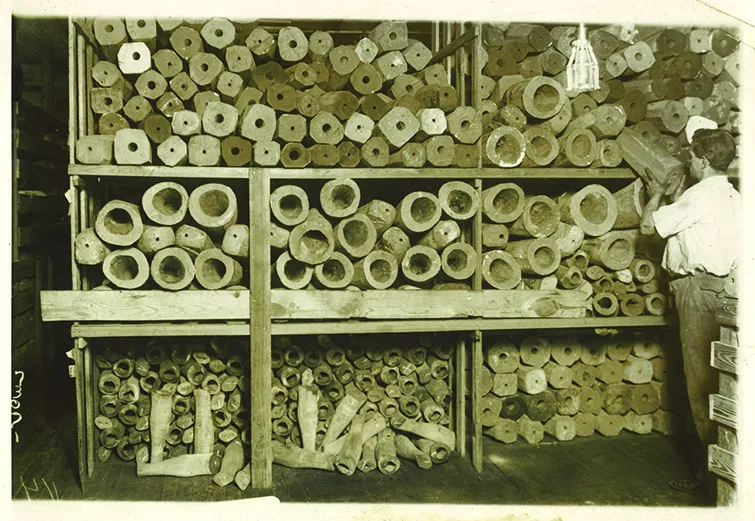
"Making artificial limbs for crippled soldiers of our allies", Hangar Artificial Limb Company, 1917
Canadian Centre for the Great War 2017.06.01
"The care of the sailors and soldiers
disabled in the War is a duty which
should be assumed by the State."
Charitable groups like the War Amputations Club (now the War Amps) and the Institute for the War Blinded provided wounded veterans with additional care. By the end of the First World War, approximately 3,460 Canadian soldiers had suffered from injuries that led to amputations, and roughly 200 were discharged as permanently blind.
An estimated 12% of the invalidated
soldiers who returned to Canada suffered from psychological injuries.
Victory Over Wounds
The Soldier's Return, [1914-1918]Library and Archives Canada
Acc. No. 1983-28-697
Image: Labour Day. Cologne. 1918 / CCGW Collection 2016.3.1.1-106
Japanese Veterans Association, c. 1918.
The Nikkei Museum, NNM 1994.70.27
The Income War Tax Act was introduced in August 1917 as a temporary measure to provide the Federal government with the necessary funds to assist veterans with employment, housing, medical attention, as well as their pensions and allowances.
It was so profitable, however, that the government decided to continue it after the war, forming the basis of the Income Tax Act that we currently have today. Revenues collected under the Act were put towards expanding social programming; much of it in the years after the war was directed towards soldiers and their dependents.
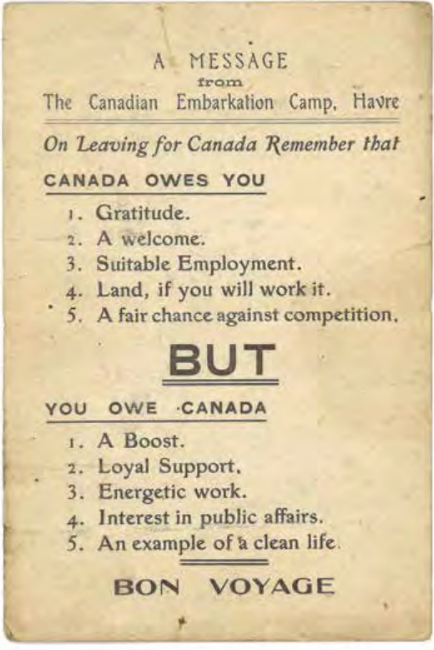
Embarkation Camp, Havre, [no date]Canadian Centre for the Great War
"It is a new departure in Canadian methods of raising money for Federal purposes."
In 1917, the Soldier Settlement Board (SSB) was set up by the Canadian government to provide returning soldiers with farmable Dominion land in Western Canada. Veterans could obtain 160 acres of land free of charge if they held a residency for six months per year for a period of three years. Dominion lands came at a cost, however; much of the offered land belonged to the Indigenous peoples of the prairies, who lost jurisdiction in favour of returning soldiers.

Speedwell [Hospital] Convalescent Ward.
[Department of Soldiers Civil Re-establishment, c. 1918]
Peake & Whittingham/Library and Archives Canada/PA-0680906
The Cost of War
Department of Soldiers Civil Re-Establishment Information
and Service Handbook for Members and Ex-Members of
the Canadian Naval and Military Forces (1919)
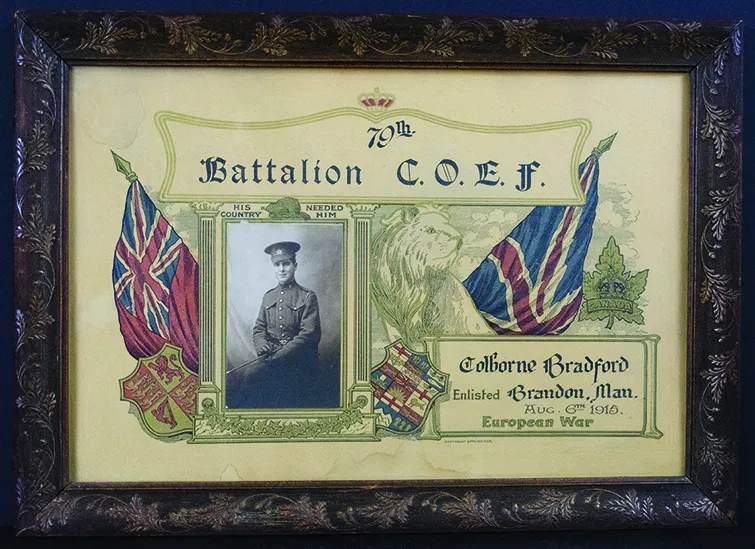
Pte. William Colborne Bradford, c. 1915.
Gift of B. Bradford, Canadian Centre for
the Great War, 2017.03.01
[book] Twenty Years After, edited by Maj. Gen. Sir Ernest Swinton, c. 1938.
Canadian Centre for the Great War
Angus Goodleaf, a member of the Mohawk Nation from the community of Kahnawake, enlisted in 1916 and was seriously wounded in August 1917. Goodleaf originally received a pension from the Pensions Board, but after a 1931 decision that turned over pensions administration to Indian Affairs, he was no longer eligible for the same amount.
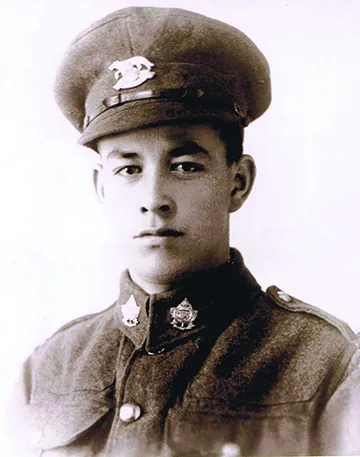
Pte. Angus Goodleaf, c. 1914-1918.
Loan of M. Goodleaf
We think you might also like...


Support Us
Enjoying our Digital Exhibitions?
Consider making a donation today to help us continue producing educational content like this.