Featured Exhibition

A Better World
Post-War Social Movements and the Canadian Veteran

Image: “13th Bn. men having a meal outside their dug-out. December, 1917” Canada. Dept. of National Defence/Library and Archives Canada/O-2332

Image: War veterans protesting lack of work [1919?] City of Toronto Archives / William James Family (Fonds 1244) / Item 903


6 min

When demobilized Canadian soldiers poured back into the country in 1919, Canadians celebrated their return with enthusiasm. However, these returning veterans faced a radically different society from the one they had left in 1914. Canada was an indebted country, marred by social crises and lacking the means to keep promises made to its soldiers during the war. In the two decades following the war, veterans would voice their aspirations for a better post-war world—fighting for equality, respect, and peace in Canada.

“Welcome to Our Boys”

Veterans Issues
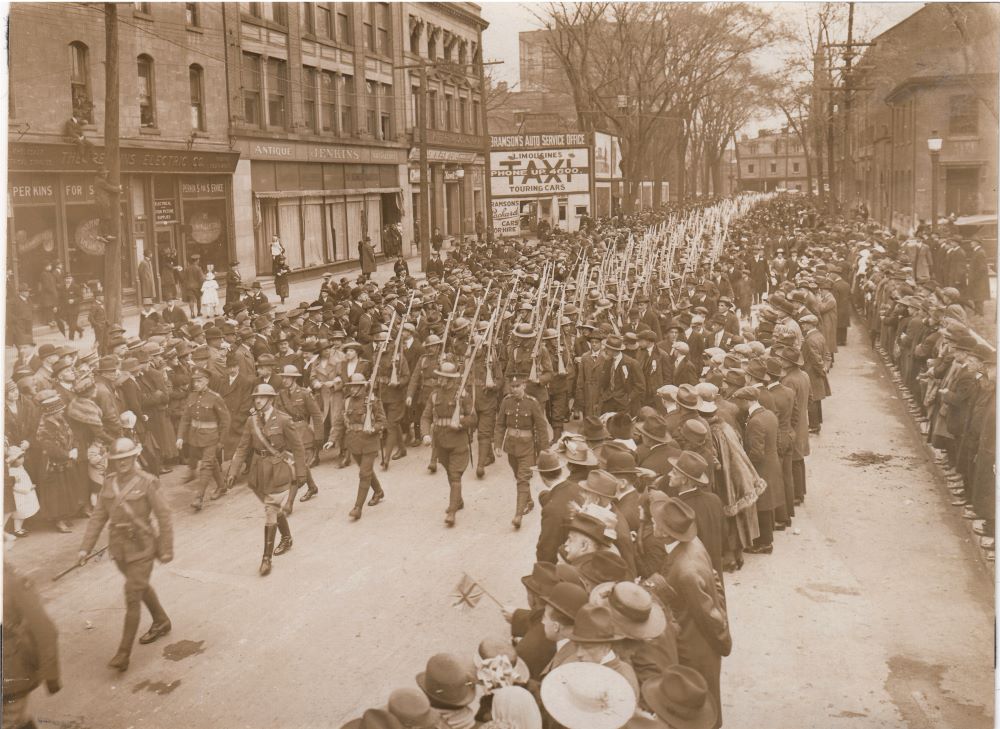
Welcome for returning Veterans [1919?] / City of Toronto Archives / William James Family (Fonds 1244) / Item 902
In 1919, the Canadian government put in place many initiatives to help the ex-soldiers’ return: Canada provided better pensions, training, medical treatment and grants than any other country involved in the First World War.
Despite these ambitious programs, it was not an easy task to return to a debt-ridden country, where jobs were scarce and the Spanish Flu was raging. After all their sacrifices, many veterans felt entitled to better government protection and fought for it during the interwar period.
Veterans’ associations for ex-soldiers of the Great War grew across the country as early as 1915 and served a dual purpose: commemoration and lobbying for improvement to veterans’ services and status.
The 1919 Bonus Campaign, which sought a $2,000 bonus for all veterans, was endorsed by numerous veterans’ associations across the country. For the Union government, this was another expense in a budget already suffering from a major deficit and despite extensive campaigning by veterans organisations. Thus, the bonus was not put in place.

Access to Pensions

By 1920, more than 177,000 disabled veterans, or widows and children of deceased soldiers, were receiving pensions from the government. Despite the impressive scale of this program, access to pensions was strict. Many requests from individuals suffering from the physical and psychological effects of shell shock and gassing were denied under the pretext that these illnesses were not attributable to war service. During the 1930s, veterans challenged these decisions, sometimes winning small grants or pensions.

“We had come back with the idea of starting in where we had left off and carrying on from there. Unfortunately, the place we had left off wasn’t there anymore. We were in a new Canada, and we didn’t know our way around, and we didn’t know whether we liked it or not.”

Veteran Norman James

YEARLY PENSION

Pensions varied according to the nature of the wound, the rank of the veteran, and the number of dependents. Today, a yearly pension of $480 would amount to slightly more than $6,400.

Nature of Illness

Loss of

2

Eyes, Hands
or Legs

1

Eye, Hand
or Leg

Maximum pension

$480

Yearly

$288

Yearly

Additional Pension for Dependents

$72

Per Dependent

$72

Per Dependent

Class Struggle

The Labour Movement

Image: Premier Norris addressing anti-strike soldiers (G. W. V. A. Great War Veterans Association) led by Capt. F. G. Thompson / 4 June 1919 / Archives of Manitoba / David Millar Collection / P8232/5
The First World War, with its increased industrial demand and labour shortages, saw the rise of socialism, unions, and workers' rights movements.
Challenging many governments' wartime measures, such as the imposition of conscription, workers fought for better working conditions with the best weapon at their disposal: strikes. In 1919, when veterans returned to the country expecting employment and finding few jobs, the movement reached its peak.
The Winnipeg General Strike, the largest strike in Canadian history, began on May 15, 1919. In a matter of days, 30,000 workers and their families had stopped working. The factors leading to this unprecedented strike were common to many major cities in Canada: poor working conditions, low wages, high inflation, absence of union recognition, and, finally, a fear of "enemy aliens" stealing jobs in factories. After six weeks, the city called in the North-West Mounted Police, who charged into the crowd, killing two strikers and ultimately crushing the movement.

STRIKES across the country from May to July 1919 

Ontario 90

Quebec 57

British Columbia 23

Nova Scotia 11

Alberta 9

Saskatchewan 9

Manitoba 6

New Brunswick 6

"Today, Mr. Borden is embarrassed. He had imposed conscription on the country: he notes, at the same time, that members of the workforce are increasingly rare, and that he needs them to save the country... what will the workers do? Will they give their cooperation to a government that has scorned them to the point of doing nothing for them?”

Montreal newspaper Le Canada, 24 January 1918

Image

Two Sides of a Coin: Veterans and the Strike

The Winnipeg general strike polarized veterans, who were almost evenly split for and against it. On the pro-strike side, Roger Ernest Bay, a former army private, became the spokesperson for veterans supporting the labour movement, leading a series of meetings and protest marches throughout May until he was arrested on charges of seditious conspiracy at the beginning of June. On the other side, Frederick G. Thompson, former army captain and lawyer, organized the anti-strike veterans’ parades. Thompson, like many other veterans, feared that the movement was a revolutionary conspiracy led by Bolsheviks.

Image: War veterans protesting lack of work [1919?] City of Toronto Archives
William James Family (Fonds 1244)
Item 903

Fighting for Recognition

Minority Rights

Afro-Canadian Unit, No. 2 Construction Battalion / Windsor Museum
Despite the racism they faced, members of Indigenous, Black, and Asian communities volunteered in large numbers to participate in the First World War. Sadly, these soldiers came back to a country largely unchanged on matters of discrimination.

Lt. F.O. Loft, c. 1914-1918
Department of National Defence
Libraries and Archives Canada
1964-114 NPC

Frederick O. Loft and the League of Indians of Canada

Returned Indigenous soldiers were not treated like other veterans. Access to the usual veterans’ benefits (doctors, hospitals, pensions, and lands) required the consent of a Department of Indian Affairs agent (DIA), which was rarely granted. Many veterans like Lieutenant Frederick O. Loft fought back, seeking more rights in exchange of their communities’ sacrifices. Loft funded the League of Indians of Canada, which fought for the rights of Indigenous peoples in Canada and to reclaim their ancestral lands.

In 1927, under the pressure of the DIA, the Indian Act was amended to prohibit organizations from raising money for Indigenous legal claims, effectively cutting the organization's funds. The League of Indians of Canada was dismantled, but its creation showed Indigenous veterans' willingness to fight for equality.

Japanese-Canadians and the B.C. Branch No. 9

Before the war, members of the Japanese-Canadian community—even those born in Canada—could not vote, run for public office or practice certain professions. Upon their return to the country, veterans from this community fought to obtain these rights. In British Columbia, Masumi Mitsui, a decorated sergeant of the Canadian army, created B.C. Branch No. 9 of the Canadian Legion to seek veterans' enfranchisement.

Ex-soldiers Japanese descent obtained the right to vote in federal elections in 1919, and, after many years of lobbying, the British Columbia legislature gave the same privilege to veterans in 1931. However, that right was stripped in 1942, when members of the Japanese-Canadian community, including Great War veterans, suffered through internment and dispossession during the Second World War.
“...Until now, Japanese Canadians have not been treated well here. But this [enlistment] will put future provincial governments in a position where they cannot deny Japanese their rights. As we look to the future as Japanese are establishing their place in Canada, we have no choice but to rise and meet the challenge.”

Iku Kumagawa, 1916, soldier in the First World War

Did you know?
Captain William A. White
While the Canadian army was not officially segregated in the First World War, Black Canadians seeking to enlist were commonly turned away by recruiters. Following two years of lobbying spearheaded by Reverend William A. White, the No. 2 Construction Battalion, an all-Black auxiliary unit, was created in 1916. White, the unit’s chaplain, was one of the only Black officers in the British Army.

A Fight for What
and for Whom?

Pacifism and Disillusionment
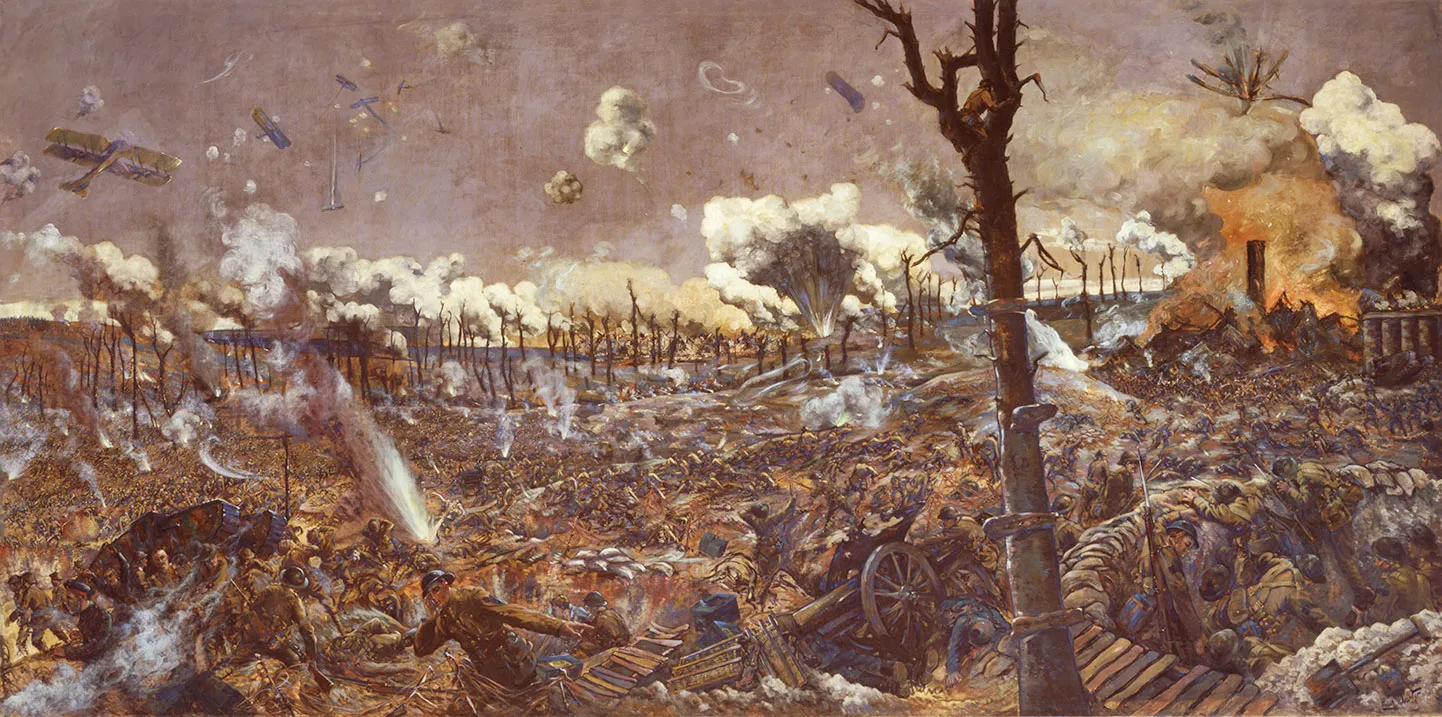
Image: For What? / Oil on canvas / By Frederick Varley, c. 1918. /Beaverbrook Collection of War Art / Canadian War Museum /CWM 19710261-0770
Pacifism emerged with new vigour following the First World War, promising an end to conflict after the carnage that had engulfed the globe. However, unlike other socio-political movements, Canadian veterans were largely uninvolved.
Before 1914, pacifism was a minor movement in Canada, largely limited to certain religious denominations and left-wing radicals. During the war, pacifists faced harsh social stigma, as well as censorship and imprisonment under the War Measures Act.
In the 1920s and 30s, pacifism was thrust into the mainstream. International projects, such as the League of Nations, an organization meant to settle disputes between states through arbitration, and disarmament and arms limitations treaties emerged, legitimizing pacifist ideology as more than a fringe movement. While not without detractors, support was fairly widespread.
While the majority of veterans shared the pacifist revulsion towards war, few transformed their disillusionment into activism—they were, as a rule, anti-war, but not pacifist. Many regarded the largely civilian leadership of the movement with suspicion or outright disdain. The failure of pacifist projects to prevent escalation in Europe was another cause for skepticism among veterans who believed that the peace that they had fought for was squandered. More than this, many veterans simply longed to put the war behind them and to lead normal lives.

Will R. Bird in Uniform
Submitted by Heather Murray

William R. Bird was a veteran of the 42nd battalion and author of numerous works, including And We Go On (1930), a biographical account of his experiences in the First World War. Less extreme than other veterans’ publications of this period, Bird’s account nevertheless has clear anti-war overtones and speaks to the perceived gap between civilians and veterans.

“And I knew that those at home would never understand. [...] We, of the brotherhood, could understand the soldier, but never explain him. All of us would remain a separate, definite people, as if branded by a monstrous despotism.”
And We Go On (1930), Will R. Bird, Canadian veteran and author
Image
Frederick Varley, as some of his fellow canadian artists, was sent to the battlefield in 1916 to document the First World War. His painting For What?, produced in 1918-1919, depicts the futility of war and challenges the legitimacy of the First World War.

For What?
Oil on canvas
By Frederick Varley, c. 1918.
Beaverbrook Collection of War Art
Canadian War Museum
CWM 19710261-0770

For Better or For Worse
1940s and 1950s
‘Employment seekers, CNE’ , [1920?] / City of Toronto Archives / William James Family (Fonds 1244) / Item 1360
Through many hardships, veterans aimed to pave the way for a better post-war world. Their dreams, beliefs, and actions contributed to the creation of the modern Canada that we know today.
Thanks to veterans’ associations and experience gained from demobilization after the First World War, the Second World War Veterans Charter was much more adapted to veteran needs. It offered training, pensions, land grants for farming and preference in appointment to civil service for veterans, like in 1918. New privileges, such as payment for university tuition or business loans, were also made available to returned soldiers.
The labour movement’s demands in the 1920s and 1930s led to the birth of the Unemployment Insurance Act in 1940. In 1948, the new Industrial Relations and Disputes Investigation Act also protected workers who wished to join a union, while forcing employers to recognize unions created by their employees.

Canadian Legion B.E.S.L. Japanese Branch No. 9 Flag, c.1930
Japanese Canadian War Memorial Committee Collection
Nikkei National Museum
2016.5.1.2.1

Veterans from marginalized communities still faced discrimination but continued to fight for more rights. Fifteen years after the end of the Second World War, indigenous peoples would obtain the right to vote in federal elections. As for Black Canadians, activists like Viola Desmond and members of the Nova Scotia Association for the Advancement of Coloured People fought for civil rights in the 1940s and 1950s. Their efforts led to the dismantlement of racial discrimination in federal immigrations policies in 1962.

Japanese-Canadians would face the horrors of confinement and dispossession during the Second World War. They would be granted the right to vote in federal elections for the second time in 1948.
While the League of Nations did not succeed in preventing the Second World War, it was the first example of a worldwide intergovernmental organization devoted to peace and collective security. Learning from its errors, the United Nations, established in 1945, shares the same goals today.

We think you might also like...

Support Us

Enjoying our Digital Exhibitions?

Consider making a donation today to help us continue producing educational content like this.

Donate